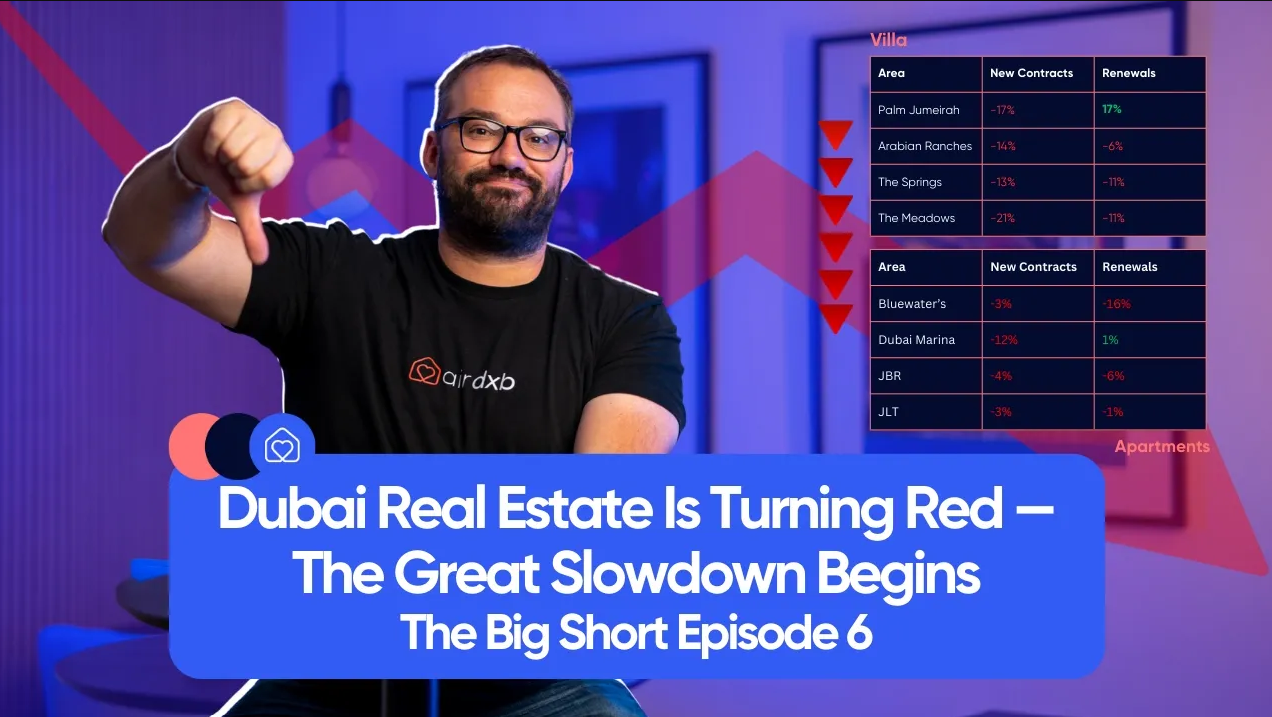
Dubai Property & Short-Let Market Q3 2026: The Market Changed Direction
Dubai’s residential sales market slowed in Q3 2026, but that is only one side of the story. Tourism continued to rebuild, short-let supply tightened and occupancy strengthened as the city moved towards high season.
.png)

Dubai entered the final quarter of 2026 with a market moving in different directions.
Residential sales have adjusted considerably from last year’s levels. At the same time, Dubai’s tourism and hospitality sectors have continued their recovery, while the short-let market entered high season with fewer active listings and stronger occupancy.
For property owners, the Q3 picture is therefore less about whether the market is simply “up” or “down” and more about understanding where demand is moving.
Residential Sales Slow
Residential sales activity softened significantly during Q3 2026.
Approximately 34,000 residential transactions were recorded during the quarter, compared with around 55,300 in Q3 2025, representing a decline of approximately 38.5% year-on-year.
Transaction value also fell, from AED 138.3 billion to approximately AED 72.6 billion, a decline of around 47.5% year-on-year.
The slowdown reflects a market becoming more selective following several years of exceptional growth.
Off-plan property, however, continued to dominate activity, accounting for approximately 72% of residential purchases and 65% of sales value during Q3.
Rather than one property market moving uniformly in one direction, Dubai is increasingly showing different dynamics across individual segments.
Short-Let Supply Tightens
The short-let market tells a different story.
By September, Dubai had approximately 20,124 active short-let listings, down 14.2% year-on-year, while the market's average daily rate remained relatively stable at approximately $125.30, down just 0.2% year-on-year.
At the same time, Dubai's September short-let occupancy reached approximately 72.4%.
Across AirDXB's own portfolio, September closed at approximately 90% occupancy, significantly above the wider Dubai market.
The combination of fewer active listings, relatively stable rates and strengthening occupancy points towards a healthier supply-demand balance as Dubai moves into its busiest months.

What Does Q3 Mean for Your Property?
Dubai’s market is becoming more selective, while tourism and short-let demand continue to recover. See how your property could perform in the current market.

Fewer Options as High Season Approaches
We also observed the change through live booking availability.
Immediate check-in searches on Booking.com showed approximately 2,800–3,200 properties available during an earlier September check, falling to approximately 2,500–2,800 one week later.
A single search cannot represent the entire Dubai short-let market, and availability changes continuously. However, the comparison provides another useful indication of inventory tightening as demand builds towards high season.
For guests, that can mean fewer options.
For owners, it creates an opportunity to focus not only on occupancy, but on how effectively that demand is converted into revenue.
Tourism Rebuilds Into High Season
Behind the improving short-let environment is Dubai's continued tourism recovery.
Dubai welcomed approximately 6.97 million international overnight visitors between January and August 2026, including approximately 869,000 visitors during August.
Hotel occupancy also recovered substantially through the year, rising from approximately 36% in March to 66% in August.
Across the first eight months of the year, Dubai recorded approximately 21.61 million occupied room nights, with hotel inventory reaching around 149,000 rooms by the end of August.
Visitor demand also remained internationally diversified. Western Europe accounted for approximately 20% of visitors, followed by South Asia at 17%, the GCC at 16%, and CIS and Eastern Europe at 14%.
For short-let operators, the continued rebuilding of tourism provides a stronger demand backdrop heading into Q4.
The Market Didn't Stop. It Changed Direction.
Q3 demonstrated why looking at Dubai real estate through a single headline can be misleading.
Residential sales ↓
Short-let supply ↓
Tourism ↑
Occupancy ↑
Residential transactions have slowed and long-term landlords are operating in a more competitive environment. At the same time, fewer active short-let listings and recovering tourism have created a different set of conditions for the holiday-home market.
As Dubai enters high season, the opportunity therefore shifts.
For short-let owners, the objective is no longer simply to fill available nights. Stronger seasonal demand creates an opportunity to protect occupancy while becoming more strategic with pricing, length of stay and revenue optimisation.
AirDXB's Q4 move: Protect occupancy. Maximise rates.
After eight years operating in Dubai's short-let market, AirDXB continues to monitor market movements, booking behaviour and portfolio performance to help owners navigate changing conditions rather than react to individual headlines.
Thinking about moving your Dubai property into short-let management? Speak to the AirDXB team to understand your property's potential for the coming high season.
Sources: Cavendish Maxwell / Property Monitor; AirDNA; AirDXB internal portfolio data; Booking.com immediate check-in comparison searches; Dubai Department of Economy and Tourism (DET); Government of Dubai Media Office; WAM; Tourism Performance Report Jan–Aug 2026.
More reports
Go beyond the headlines. Access a comprehensive collection of Dubai property news, keeping you ahead of the curve in this dynamic market.